Practically Radical

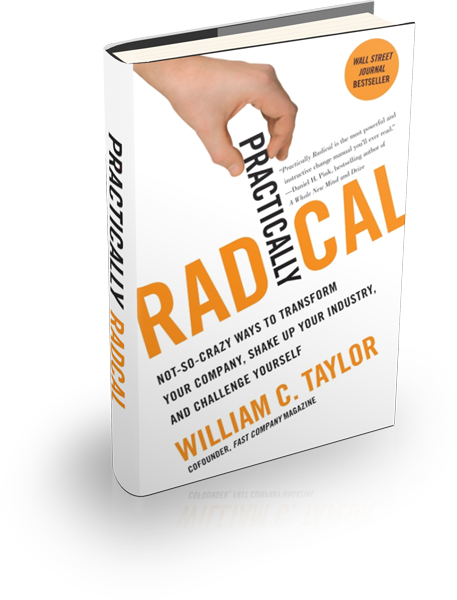
"The most powerful and instructive change manual you'll ever read."

- Daniel H. Pink, bestselling author of
A Whole New Mind and Drive
Wall Street Journal Bestseller!
#1 Bestseller! Inc./800CEORead
 
October 5th, 2011

Slickest Plane Ever?

Just learned about an airline called Kulula.com, sort of the Southwest of South Africa, but with an even more effervescent personality. Check out this plane. What a fun exterior!

Line Break
Line Break
Line Break
October 5th, 2011

How to Lead After a Legend

It’s tough as a new CEO to fix a troubled company suffering under a legacy of misleadership, as Meg Whitman is about to learn at Hewlett-Packard. But it’s even tougher to follow in the footsteps of an icon—a leader who didn’t just win big with the company, but changed the game in the industry.

Just ask James Parker, who took over at Southwest Airlines after the larger-than-life Herb Kelleher, and stepped down after three underwhelming years. Or ask Jeffrey Immelt, who has spent a decade as CEO of General Electric, but still can’t escape the shadow of Jack Welch, Fortune’s “Manager of the Century” for the 20th century.

So it’s fair to say that Tim Cook, Steve Jobs’s successor at Apple, is stepping into the toughest job imaginable—taking over for everyone’s choice as “Manager of the Century” for the 21st century. How should Cook lead in the footsteps of such a legend? Over the weekend, The Washington Post asked me to write about that question. You can find my answer, in the form of an essay, here.

Line Break
Line Break
Line Break
September 25th, 2011

How HP Lost the “HP Way”

Really, Hewlett-Packard? This is what’s become of the company of Bill and Dave—not just the founders of HP, but the founding fathers of Silicon Valley? Three CEOs in six years. Two of those CEOs who embarrassed themselves with pathetically inept campaigns for elective office. The other CEO who managed to get tossed out of his job by virtue of his (still largely unexplained) fascination with a B-level (and that’s grading generously) actress. Not to mention boardroom soap operas, front-page ethics scandals, and more changes of direction than a surfer in a hurricane.

It’s hard to argue with the assessment of Thomas Perkins, the legendary venture capitalist and a former HP director (who has hardly covered himself in glory during this mess), who told the New York Times back in August: “I didn’t know there was such a thing s corporate suicide, but now we know that there is. It’s just astonishing.”

Here's my take for HBR on the "astonishing" decline of Hewlett-Packard, which has been reposted on Bloomberg BusinessWeek as well. Great debates on both sites! How would you fix HP?

Line Break
Line Break
Line Break
September 1st, 2011

Why Steve Jobs Matters to You

All sorts of commentators are asking all sorts of questions about the resignation of Steve Jobs as CEO of Apple, Inc. What does it mean for the company’s future? What does it means for the stock price? What does it mean for the computer industry, the music industry, and the media industry?

All fine questions, to which I would add one more: What does it mean for you? Or, to put it another way, when you see the outpouring of affection, respect, and admiration for this one leader, an outpouring of emotion that I can’t recall for the departure of any other businessperson or technologist, isn’t it natural to think about your own eventual departure, the legacy you’ll leave behind, the ways in which your career will be remembered?

Few of us have the chance to achieve 1/100th of what Steve Jobs has achieved. But all of us can look at his body of work, and the reaction to that body of work, and use it as an opportunity to ask more of ourselves as leaders and innovators with a chance to make a small positive difference for our industry, our customers, and our colleagues.

Here's my latest post for Harvard Business Review.


Line Break
Line Break
Line Break
August 16th, 2011

The Great “Great People” Debate

My HBR posts on "Why Great People are Overrated" continue to kick up some dust. This morning, the NPR program "Here and Now" devoted a 14-minute segment to an interview with me on the battle for talent in Silicon Valley, and my reservations about what's going on.

What a fun time-- a serious topic, but lots of laughs too. You can listen to the segment here. The interview starts at the 5:30 mark.

Line Break
Line Break
Line Break
August 16th, 2011

Creative Explosion–Lessons from the Fringe

This has been an explosive summer—markets in turmoil, cities in flames, politics in meltdown. So it’s a relief to enjoy and learn from an explosion of a different sort—the explosion of creativity taking place this August in Edinburgh, Scotland, at the renowned Edinburgh Fringe Festival. The festival, a one-time icon of artistic rebellion, is now the largest arts gathering in the world. It is also an entertaining case study in the power of grassroots innovation and open-source creativity—a positive symbol of how unchecked human energy, shaped by a few simple rules, can unleash truly amazing results.

Here's my take on how "The Fringe Beats the Mainstream," on my HBR blog.

Line Break
Line Break
Line Break
July 12th, 2011

How Do You Know a Great Person When You See One?

In the still-raging debate over my two HBR posts about why “Great People Are Overrated,” the one (and perhaps only) question that went under-discussed might be the most important question of all: How do you know a great person when you see one? In other words, is “greatness” purely a matter of raw brainpower and technical virtuosity, or is it impossible to discuss individual talent without thinking about the team, the enterprise, and the very mission of the organization?

Here, then, is the final installment in my Great People Trilogy for HBR, designed to help you answer that question. Join the discussion!

Line Break
Line Break
Line Break
July 7th, 2011

Are You “Humbitious” Enough to Lead?

The folks at the esteemed Leader to Leader Institute publish a quarterly journal called, not surprisingly, Leader to Leader. What is surprising is that they saw fit to ask me to write an essay on what it means to lead in a world where nobody alone is as smart as everybody together.

Well, the Summer 2011 issue out, and it includes my essay. You can read it on the Web here.

Line Break
Line Break
Line Break
June 23rd, 2011

Overrated, Part II

I’m pleased, although not surprised, by the incredible wave of reactions to and comments about my post, “Great People Are Overrated.” (I’m also not surprised by the vitriol and personal nature of some of the barbs aimed at me—that seems to go with the territory whenever you question an article of faith among the Web startup crowd.)

My guess is that the post touched a nerve because it touched on one of the great dividing lines in our business culture today. As members of an economy, a society, and a collection of companies, all of us are engaged in a conversation (sometimes explicit, mainly implicit) about what makes the world go ‘round—individual brilliance or group genius, self-possessed superstars or well-rounded teams.

This is not a strictly either-or choice, of course. Even the best groups have stars, and not all stars find it hard to work well with others. But there remains the question of balance, priorities, even business mythology. If we’re building a company, what sorts of people do we want to recruit? If we’re paying our people, what sorts of contributions and behaviors do we wish to reward? If we’re thinking about our country and society, what kind of outcomes are we comfortable with, in terms of wealth and income distribution? Ultimately, are we fielding a team, or assembling a collection of individuals?

To get a sense of my answers to those questions, check out my new post on HBR, "Great People Are Overrated (Part II)."

Line Break
Line Break
Line Break
June 20th, 2011

Great People Are Overrated

Last month, in an article in the New York Times on the ever-escalating “war for talent” in Silicon Valley, Facebook CEO Mark Zuckerberg made a passing comment that has become the entrepreneurial equivalent of a verbal tick—something that’s said all the time, almost without thinking. “Someone who is exceptional in their role is not just a little better that someone who is pretty good,” he argued when asked why he was willing to pay $47 million to acquire FriendFeed, a price that translated to about $4 million per employee. “They are 100 times better."

Zuckerberg’s casual calculation reminded me of a conversation with Marc Andreessen, the legendary cofounder of Netscape, and now one of Silicon Valley’s most high-profile venture capitalists. “The gap between what a highly productive person can do and what an average person can do is getting bigger and bigger,” he told Polly LaBarre and me for our book, Mavericks at Work. “Five great programmers can completely outperform a thousand mediocre programmers…”

Now, I admire what Mark Zuckerberg has built, and I consider Marc Andreessen without peer as an entrepreneur and a thinker, but do we take seriously what these two Silicon Valley giants claim about talent? If you are building a company, would you prefer one standout person over one hundred pretty good people? If you were launching a technology or developing a product, would you rather have five great engineers rather than one thousand average engineers?

Have we become so culturally invested in the allure of the Free Agent, the lone wolf, the techno-rebel with a cause, that we are prepared to shower millions of dollars (maybe tens of millions) on a small number of superstars rather than a well-assembled team that may not dazzle with individual brilliance, but overwhelms with collective capability?

Check out my answers in my latest blog post for HBR. Join the discussion!

Line Break
Line Break
Line Break
Line Break