Leading change is both a top-down process and a bottom-up process. The goal is to educate and energize colleagues at every level, especially those on the front lines, about the power of your plans, and to be educated and energized by the pragmatic wisdom of their experiences. Change programs work when they shape the behaviors and unleash the enthusiasm of the people closest to the work — the technologists who write code, the front-line employees who interact with customers, and customers themselves, who have the deciding vote on whether a company is doing something worthwhile. Put simply, it’s hard to reach people’s hearts and minds if the CEO’s head is in the clouds.
Author Archive
HBR: Unleash Your Organization’s Overlooked Talent

Leaders everywhere are desperate for new insights, new products, new sources of energy and creativity. One way to find those things is to embrace new ideas about who gets to contribute and how, whether they are inside or outside the organization. The author points to two examples: the art exhibition “Guarding the Art” and John Fluevog’s “Open Source Footwear” program. As he writes, “One of the most energizing ways to make your organization more productive and successful is to invite more people to contribute more of themselves to its success.”
HBR: To Find Creative Solutions, Look Outside Your Industry

The chaos and crises of the last two years have created all kinds of questions for leaders and organizations. One of the biggest questions is: Do we have new ideas about where to look for new ideas? When it comes to innovation and problem-solving, there will always be a place for old-fashioned, time-consuming R&D — research & development. Today, though, there is also a place for a different kind of R&D — rip off and duplicate. The fastest way for organizations to make sense of challenges they are seeing for the first time is to survey unrelated fields for ideas that have been working for a long time. Why gamble on untested strategies and insights if you can quickly apply strategies and insights that are already proven elsewhere? That’s how leaders can help their colleagues keep learning as fast as the world is changing.
Fast Company: This Brazilian billionaire should be your role model for corporate activism

Super-rich entrepreneurs love to explore brash endeavors outside the mainstream of their business—say, the high-profile space race between Jeff Bezos and Elon Musk, or Larry Ellison’s obsession with the America’s Cup. But it remains genuinely rare, and worthy of attention, when a billionaire entrepreneur takes a hard look at the society around their business and commits to brash endeavors to challenge inequality, racism, and the crisis fueled by COVID-19.
HBR: How Leaders Can Balance the Needs to Perform and to Transform

These are trying times for optimists. Covid deaths remain tragically high. Job growth remains stubbornly low. So There has never been a tougher time to be a leader, whether that’s running a big company or being in charge of a small team, Bill Taylor writes in this piece. He offers three sets of questions to help leaders focus on what’s important right now. The first set involves managing time: how to handle the chaos of the present while also creating space to focus on the future. The second set involves the personal stress of leadership: how to solve problems that your organization has never encountered before, without burning out or giving up? The third set involves rank-and-file morale: how to encourage people to stay upbeat and energetic when it is so easy to feel anxious and beaten down. If you can devise answers to these three sets of questions, you have a chance to pass the leadership test of our time.
HBR: Great Leaders Understand Why Small Gestures Matter
I travel a lot of for business, and like most frequent flyers, I dread connecting flights. Except, that is, when those connections take me through Denver or Charlotte, where the prospect of an hour between planes brings a smile to my face and a spring to my step. Why the good cheer? Because I know I’ll be able to spend time with the men and women of Executive Shine, one of the most soulful (or is it soleful?) businesses I’ve ever encountered.
HBR: To Build a Strong Culture, Create Rules That Are Unique to Your Company
Ben Horowitz, the high-profile venture capitalist behind some of Silicon Valley’s fastest-growing startups, is out with an intriguing book, called What You Do Is Who You Are, that emphasizes the power of culture, rather than technology or money, as a driver of business success. One of his most intriguing insights is that powerful cultures are built around what he calls “shocking rules” — rituals and practices that are memorable, so “bizarre,” that people inside the organization “encounter almost daily” and that people who hear about them wonder why they are necessary.
Horowitz’s argument is as simple as it is powerful: You can’t create something unique and compelling in the marketplace unless you first create something unique and compelling in the workplace. Truly great organizations work as distinctively as they hope to compete.
HBR: Do You Give Employees a Reason to Feel Proud of What They Do?
I recently visited Wake Forest University, in Winston-Salem, North Carolina, where I serve on the College Board of Visitors. The campus was buzzing — in part because the weather was so nice, in part because the football team had cracked the national Top 25. But much of the warm feeling was the afterglow of a recently completed, larger-than-life dance extravaganza starring the school’s facilities-and-maintenance staff.
You read that right. For three nights, nearly 70 custodians, landscapers, electricians, and construction crews performed in the school’s main Quad, where thousands of students, faculty, alumni, and neighbors roared their approval.
HBR: To Come Up with Better Ideas, Practice Paying Attention
We live in a world where virtually every business is an “ideas” business. Executives and entrepreneurs are desperate for insights that allow them to amaze customers, reimagine products, and otherwise separate themselves from the crowd. But it’s hard to see new things if you don’t know how to pay attention, how to cut through the endless meetings, messages, and emails, how to really listen to and begin to decode what’s happening in the world that truly matters to your organization.
Bill’s Books
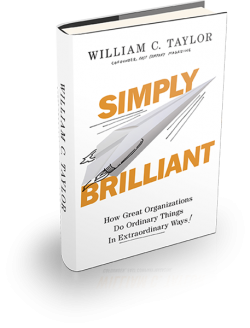
Simply Brilliant
How Great Organizations Do Ordinary Things in Extraordinary Ways
Learn More
Amazon.comBarnes & Noble800ceoread.comIndieBound.comBooks-A-Million